Chinalure
Show Reports & Company News · From the Factory Floor and the Show Floor
The eight-tail mouse: a hand-tied night lure for pike and taimen
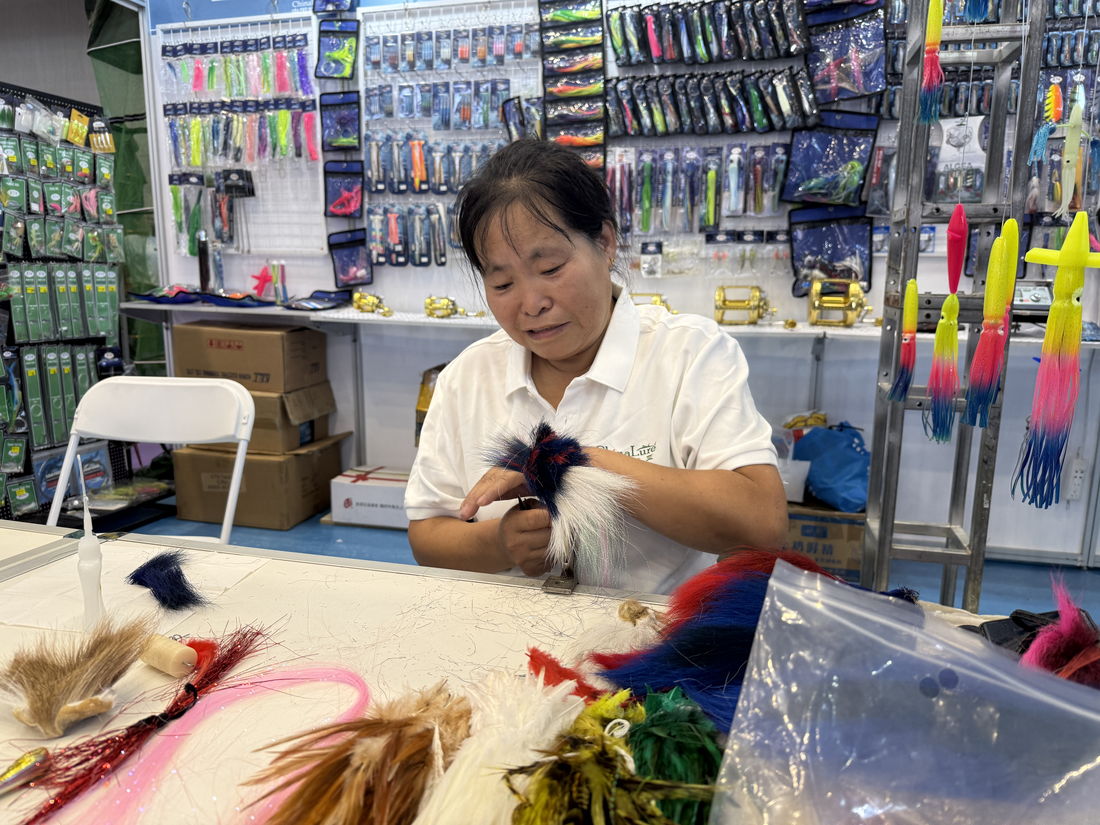
Our booth splits in two on show days. One half is the display wall. The other half is the tying table at the back, where the fur, feathers and flash sit in loose piles next to a tray of gold spoons and jig heads. On opening morning one of our tiers sat down at that table before the first visitors arrived, and she didn't leave it until the aisles started to thin out in the afternoon.
The visitors who stayed longest were the ones from the Russian market, and that's no accident. In Russia the mouse isn't a novelty bait. It's a category of its own, tied for the fish that sit at the top of the chain in the big northern rivers.
Why a mouse
Through July and August the banks of the northern rivers are busy with rodents. Water voles and field mice fall in while crossing and swim for the far side, and the fish sitting below them know exactly what that looks like from underneath. A pike or a taimen that spends most of the year on baitfish won't pass up a swimming rodent, because the meal is large and the escape is slow.
That's the whole trick of the pattern. It isn't fished for how it looks from the boat. It's fished for the two things a fish sees from below: a wake pushed across the surface, and a silhouette with a long tail trailing behind it.
What it is fished for
| First target | Taimen (Hucho taimen), the largest salmonid in the world. Fish past 1.5 metres and 30 kilograms have been recorded, and anglers in Siberia and the Russian Far East plan entire expeditions around them. A surface rodent is one of the few patterns that will pull a big one up out of a deep pool. |
|---|---|
| Second target | Northern pike. In much of Europe and Russia the biggest pike of the season come after dark, in water less than two metres deep, and a mouse is a standard tool for them. |
| Also taken | Asp, large perch, lenok, char and grayling, usually as a bonus fish rather than the plan. |
| Season | Late June through September. July and August are the strongest weeks, once the water has warmed through. |
| Hours | The last hour of light through to about two in the morning, then again in the grey before sunrise. On a northern river in mid summer the sky never goes fully black, and that half light is often the best window of the night. |
| Water | Half a metre to two and a half metres deep. Flats, backwaters, eddies, the water under a steep bank, flooded timber, and the mouth of a tributary. |
How big they are built
There's no single size, but the pattern normally sits inside these numbers. Heavier builds for taimen take the top of each range.
| Body length | 6 to 9 cm for pike, and 10 to 16 cm for taimen. |
|---|---|
| Weight | 15 to 25 g for pike, and 40 to 90 g for the big river versions. |
| Hooks | Two as standard, one at the tail and one under the belly, in 4/0 to 8/0 depending on body size. |
| Rod | 2.7 to 3.3 m, rated 40 to 100 g, mid-fast action. |
| Reel | 5000 to 7000 size spinning reel, 5.4:1 to 6.2:1. |
| Leader | A wire trace. Every time, for pike. |
Why eight tails and not two
A soft tail does two jobs on a surface lure. It drags on the water and keeps the head sitting up, and it keeps moving when the lure is barely moving. Two tails manage that at a normal retrieve. Eight keep working when the retrieve is almost stopped, and that's what the biggest fish in cold northern water ask for. The tails splay out and work against each other, so the lure keeps a slow ripple running even when it's drifting.
There's a practical side for a shop as well. Tails wear out long before the head does. Sold as a spare part, a set of replacement tails brings a customer back several times over the life of one lure.
How it is fished
- Cast past the fish and let the lure sit until the rings have gone flat.
- Retrieve slowly and evenly, one to two turns of the handle per second. If you think you're going too slow, go slower.
- Every few metres, give the rod a short pull. The head dips, the tails flare, and the lure starts swimming again.
- Don't strike at the splash. Wait until the lure disappears or you feel weight on the line, then set the hook.
- Use a wire trace. A pike will cut a fluorocarbon leader without slowing down at all.
Work the lure along the edge of a weed bed or down the line of a bank rather than across open water. At night the fish are usually within a metre or two of something they can hide against.
What goes into one
Everything on the tying table earns its place by being visible at night. The piles in front of our tier during the demo were:
- Natural fur in several colours, loose and uncut, for the body and the tails.
- Saddle hackle and marabou type feathers, for movement while the lure drifts.
- Holographic flash and tinsel, for the little light a night lure picks up from the sky.
- Pre-tied tinsel tails in yellow, pink and blue, hung on the ladder behind the table to dry.
- Thread and a bare hook shank, which is where every one of them starts.
A note for buyers working the Russian market
Russian anglers search in Russian, so the two words that carry weight on a product page are мышь (mouse) and ночная ловля (night fishing). Chinalure has been building lures in Weihai since 2003 and has exhibited at all eighteen editions of this show, so most of the Russian buyers who come to the table already know the pattern by name.
The shops that move it well tend to do two things. They carry the tails as a separate line, and they show the lure being tied rather than only finished. Both point the same way: the pattern is made, not moulded, and that's what separates a hand-tied mouse from a mass-market floating frog.
If you know this pattern under a different name in your market, tell us and we'll print your name on the label. We build these to order in your colours and your tail count, and hand-tied work is easy for us to label to your own artwork.
Write to young@chinalure.com with a photo or a sketch of what you need. If you're at the show, bring it to booth E2 2125 and we'll tie the first one at the table. Our full report from opening day is on the show reports page, and the story of our eighteen editions at this show is on the CGC page.
Not attending the show? You can still get our 2026 catalog and price list by email.
Write to young@chinalure.com or call +86-631-2660217.